Skip to content

AfterLife Posts

181. la nación, 11 mar 2008

Receiving 2,000 visitors each day, Recoleta Cemetery renews its historical brilliance; more than 100 monuments have already been restored & works continue this year.

Byline: Susana Reinoso

María Rosa Lojo writes about Recoleta Cemetery: “In this museum of mortals, the personal ramblings of its inhabitants —famous or obscure— blend inextricably with Argentine history.” In her work Hidden Stories of Recoleta which was just republished by Alfaguara, the novelist exquisitely states that whoever walks with their ears alert can hear in the cemetery, one of the most popular places in Buenos Aires for tourists, “the murmor of remarkable lives against the immense chorus of collective memory.”

Precisely because this mortuary museum brings together much of the best funerary architecture & statuary in Buenos Aires, the city government will continue the Recoleta Cemetery Revaluation Program, which aims to conserve & restore the sculptures, vaults, sepulcres & tombs. Approval [for continued funding] came at the end of 2007.

With the intervention of the Subsecretary of City Heritage, the Friends’ Association of Recoleta Cemetery —headed by Marta Salas— and the General Administration of Cemeteries —whose director is Néstor Pan— they have completed since 2002 a remarkable plan of recovering that architecture.

Art & Remembrance

Each day the cemetery receives an average of 2,000 visitors. That equates to more than 700,000 people per year since the cemetery is open Monday through Sunday.

“Over 100 monuments have already been recovered, & we rely on group of highly qualified restorers who work with love & a sense of patriotism,” says Marta Salas to La Nación newspaper.

The President of the Friends’ Association points out: “This effort comes from the fact that we consider Recoleta Cemetery to be the most relevant historical/artistic space in our country, & we are proud to show it to the thousands of tourists who visit it.” The organization, which sells detailed maps of the cemetery to tourists, uses part of the proceeds for restoration of historical monuments.

A brief walk through, like the one taken by La Nación reporters, confirms this. The crowds never stop coming, & there are not enough guides to answer every question. Visitors always make a pilgrimage to the sepulcre of Eva Duarte de Perón.

The director of the cemetery, Carlos Francavilla, states that the revaluation of the cemetery is not [immediately] visible to most people. However the scaffolding & work materials around certain monuments make people realize that restoration is in progress.

This year the program has planned to restore the sculptures & vaults of Adolfo Alsina, Nicolás Rodríguez Peña, Juan José Viamonte, Rufina Cambaceres & Pedro J. Díaz.

In each instance, the work of restoration & maintenance carries out the elimination of invasive vegetation, replacement of missing material, elimination of the deteriorated outer layer, chemical cleaning & an anti-corrosive treatment.

In 2006, restoration was performed on the sepulcres & mausoleums of Bartolomé Mitre, Domingo Fidel Sarmiento, Carlos Pellegrini & Juan Martín de Pueyrredón. Last year, works focused on the mausoleums of Luis María Campos & Nicolás Avellaneda, the vault of the José C. Paz family, the Pantheon for Meritorious Citizens & the sculpture of Christ in the cemetery chapel.

———————————

Original article in Spanish located here.

Leave a Comment

180. smoky sunset

Smoky sunset, Recoleta Cemetery

Thanks to two weeks of brush fires north of Buenos Aires, the city is now covered with a thick layer of smoke. The cemetery makes a perfect foreground for yesterday’s apocalyptic sun.

Leave a Comment

179. entrance gate

Entrance gate, Recoleta Cemetery

When founded in 1822, the cemetery grounds were humbler than the miniature city of mausoleums which can be visited today. The main entrance was nothing more than a wrought-iron gate without much decoration, & the area was enclosed by an adobe-cement wall. Buenos Aires mayor Torcuato de Alvear sponsored large urban makeovers of the city & Recoleta Cemetery was on his list. In 1881, plots randomly located among dirt paths gave way to orderly sectors & paved walkways.

Juan Buschiazzo designed an appropriately elegant main entrance. He was the obvious architect of choice for Alvear, responsible for some of the poshest mansions in town. Buschiazzo incorporated the original structure into the new gate, adding columns & a frieze filled with symbols related to Christianity & naturally, death. Click on the links below to discover the meaning of each symbol:

“Rest in peace” in Latin tops the gate, leaving little doubt as to what’s inside. The above symbols are also repeated on the interior façade of the gate along with a small bell & the phrase “Expecatamus Dominum.” Taken from Philippians 3:20, it can be roughly translated as “We await the Lord.”

The gate was listed as a National Historic Monument in October 2007.

Leave a Comment

177. juan facundo quiroga ◊

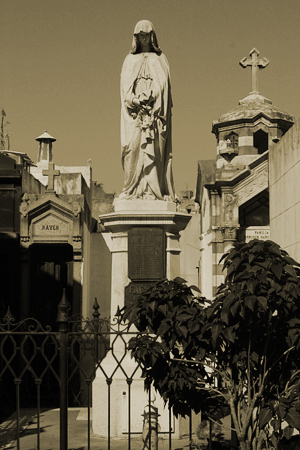
Juan Facundo Quiroga, Recoleta Cemetery

Born in La Rioja, Quiroga received the nickname “Tiger of the Plains” based on his adeptness in battle. It was a skill needed during the troubled times of early independence from Spain when Argentina struggled to reach a consensus on national government.

When Argentina broke away from Spain & earned its independence in 1816, some people wanted to invite a European monarch to establish their own kingdom… sort of an Empire of the Río de la Plata. The idea isn’t far-fetched since Brazil was a separate Portuguese empire at the same time. But those in favor of a monarch didn’t have the majority.

The biggest issue centered on the role of Buenos Aires in the new nation, specifically the money it received from port taxes. Unitarios wanted Buenos Aires to become the capital city & keep all revenue from international trade. Opposing federales wanted a confederation—an alliance among equals—which would commit Buenos Aires to give other provinces access to their income. Definitely a touchy issue.

As the major port of the nation, foreign trade brought lots of money into Buenos Aires & exporters wanted to maintain the status quo. By placing the national capital in the same spot as the economic center, Federalists feared that the rest of Argentina would be neglected. In the end, the struggle over Confederation vs. Republic was settled in favor of Buenos Aires. Unitarian predictions came true as national growth has been skewed toward the capital ever since.

A strong supporter of BsAs, Quiroga thought that Rosas could resolve the conflict & pledged his support. But when Rosas began ruling Argentina like a monarch, Quiroga switched sides. Ignoring warnings of a conspiracy against his life, Quiroga was ambushed & killed in central Argentina. Eventually his remains were transferred to Recoleta Cemetery.

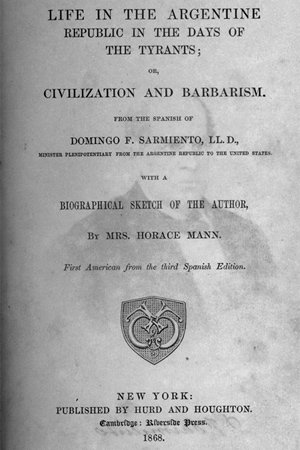
His place in history was guaranteed when future President Domingo Sarmiento wrote a harsh biography of Quiroga… still required reading in the Argentine curriculum. For Sarmiento, Quiroga embodied the stereotype of the gaucho: unable to think off his horse, wild, savage, & the opposite of progress. Not the most accurate of depictions, this image of Quiroga served to promote urban development at a time when Argentina needed guidance:

Sarmiento, Facundo, Recoleta Cemetery

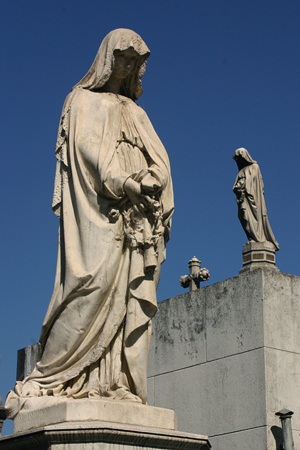
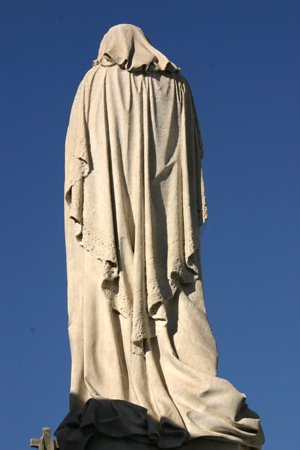
Quiroga’s story is interesting but so is his tomb. Although weathered over time, the statue of Mary is a beautiful work of art made of Italian artist Antonio Tantardini. Note the delicate lacework details on her shawl. And yes, you’re seeing double. A miniature copy of this statue crowns the dome of another tomb nearby:

Juan Facundo Quiroga, Recoleta Cemetery

Juan Facundo Quiroga, Recoleta Cemetery

Legend claimed that the coffin of Quiroga was buried upright, perhaps so he would be one of the first out during the Second Coming of Christ. Excavations in 2004 confirmed his fate… Quiroga was indeed buried upright, hidden behind a wall underground. He was controversial enough that family & friends were afraid someone might break into the cemetery to deface his remains. Sure, it’s gruesome, but that’s one way to have the last word… when your opponent can’t fight back.

3 Comments