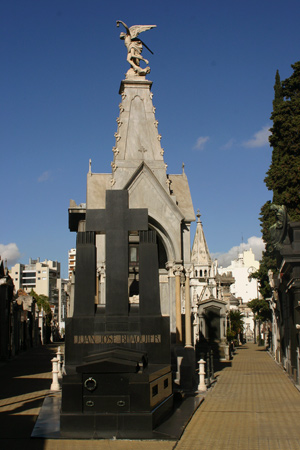
Back rows are aligned just right for a lengthwise view of the entire cemetery. To the right of Blaquier’s tomb at the end of the aisle is the sculpture group for Juan Alberto Lartigau.
Leave a Comment
Back rows are aligned just right for a lengthwise view of the entire cemetery. To the right of Blaquier’s tomb at the end of the aisle is the sculpture group for Juan Alberto Lartigau.
Leave a Comment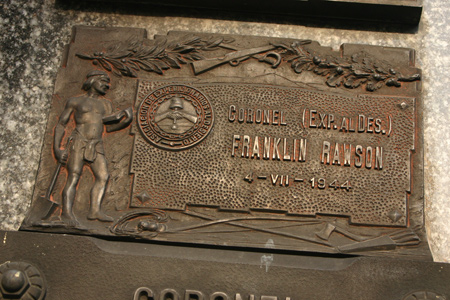
When one of the defining moments of a nation’s history has three distinct names, controversy forces people to choose sides. Choose carefully between Campaña del Desierto, Expedición al Desierto or Conquista del Desierto… it reveals a lot about your political beliefs.
For most of the history of Buenos Aires, it was connected only to other cities upstream from the Tigre Delta. At odds with the indigenous people to the south, the Spanish began to carve out extra territory for themselves as did Argentines after independence. By the 1870s, successive campaigns had re-drawn the southern limit of the nation & gradually pushed it west at the same time. The map below shows these waves of expansion as they moved further away from the red dot of Buenos Aires:
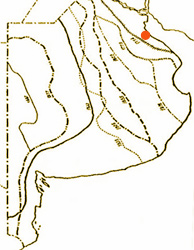
In an effort to raise government funds & acquire new territory, the nation put all land south to the Río Negro up for sale. Fewer than 300 families purchased estates that added an important expanse to Argentina. The sale also concentrated national power in the hands of a few. The only problem was that the land sold by the national government was not technically theirs… yet. Various indigenous tribes were living there, so the Minister of War was sent to “deliver” the land to its new owners.
In 1879, Julio Argentino Roca marched the Army into indigenous territory with modern weapons & killed an estimated 4,000 during the course of the fighting. About 14,000 were taken prisoner, marched to Buenos Aires while shackled, & separated based on sex. Some were used as conscript labor & some were jailed, but the end result was akin to genocide. Roca’s tactics also stopped a persistent problem of raids on cattle ranches & farm land. Capitalizing on his military success to launch a long political career, Roca was elected President in 1880.
Call it what you will, the fact that European immigration was desired just as enormous tracts of land needed to be worked made Argentina what it is today. Many of the upper-ranking officers who participated in this event are buried in Recoleta Cemetery… just pay attention to the plaques. From my point of view, these images are so politically incorrect that they would be funny if it weren’t so tragic.
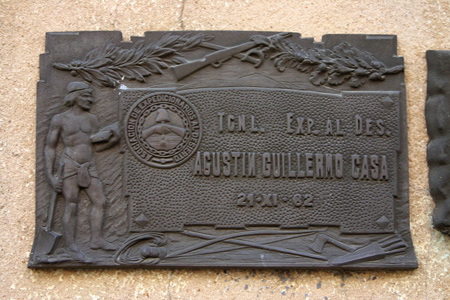
A gun & sword top an entire array of indigenous weapons: a quiver of arrows, a hatchet, a lance, a bow & even a boleadora. In exchange for leaving the instruments of war aside, an indigenous man can now work the land with a shovel & improve his intellect by reading. No further comment necessary.
1 Comment
This new addition doesn’t seem to fit within the general artistic quality found in the rest of the cemetery. Glass doors are common in modern mausoleums but are typically etched with symbols already mentioned in this blog or simply left without decoration. Although the door is very different, it’s not horrible… but the garden statue placed on top really needs to go:

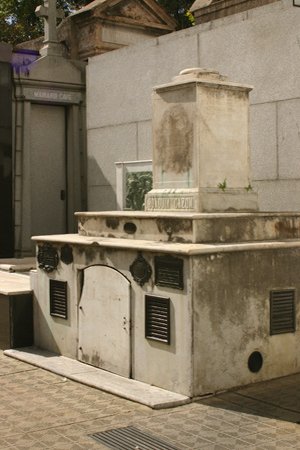
Unassuming & rather neglected, one of the founding fathers of Argentina lies inside. Nicolás Rodríguez Peña was born in 1775 in Buenos Aires & after a short stint in the military, he decided to go into the soap business with Hipólito Vieytes. Vieytes & Rodríguez Peña turned out to share more just than commercial interests… they were responsible for gathering support to declare independence from Spain in 1810. Discreet meetings took place either in the soap factory or at the country estate of Rodríguez Peña.
The early years after independence were rocky ones. In 1812, Rodríguez Peña formed part of a brief triumvirate government along with Juan José Paso & Antonio Álvarez Jonte. But factions came & went, & so did Rodríguez Peña’s influence in Buenos Aires. Eventually caught on the wrong side, he chose to join San Martín in ousting the Spanish from Chile & remained there after the decisive battle in Chacabuco. Spending 37 years away from Argentina, Rodríguez Peña died in Santiago de Chile in 1853.
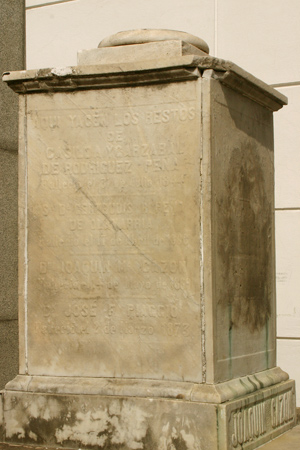
His remains were brought back to Buenos Aires in 1894 & placed in Recoleta Cemetery in a family vault built after his departure from Argentina. On the base of the pedestal, a list of family members related to Nicolás includes his wife, Casilda Ygarzábal de Rodríguez Peña, who passed away in 1844 & Joaquín who died in 1869:
Small plaques below the pedestal are the only reminder that Nicolás is buried here:
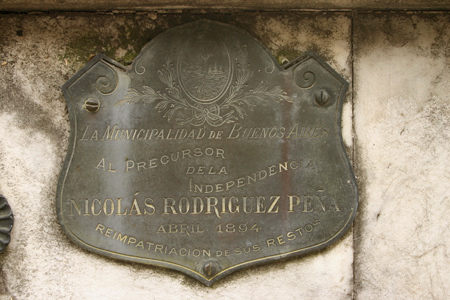
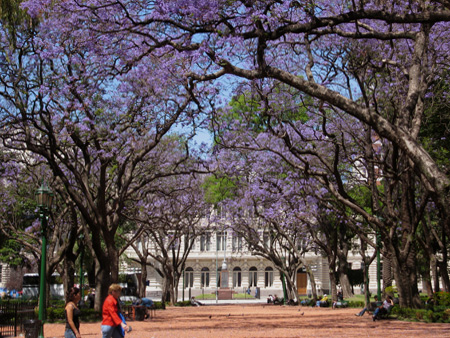
The participation of Rodríguez Peña in the independence of South America is noteworthy not only because of his constant participation regardless of internal conflicts, but also because he used his entire fortune to support the cause. Now that’s dedication. This tomb was declared a National Historic Monument in 1946 & is scheduled for restoration later this year. Unfortunately nothing remains of the estate in Buenos Aires where revolutionary meetings were held, but that location is now a beautiful public square filled with jacarandá trees which bears his name… Plaza Rodríguez Peña:
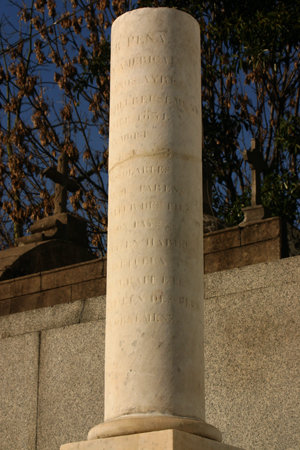
Update (Jun 2008): About one year after this post was written, the crypt was restored & the column replaced. Text on the column is in French—some unreadable & with mistakes—but the general idea is easily conveyed:
N. R. Peña / jeune americain / de Buenos Ayres / mort malhuereusement / le 13 janvier 1831. / Sa mort / à laissé ses amis [column broken] / inconsolables / à prive ses parens / du meilleur des fils / et son pays / d’un citoyen habile / et vertueux / quien aurait été / sans doute lux des plus / beaux obnemens [difficult to decipher]
N.R. Peña, young American from Buenos Aires, sadly died the 13th of January 1831. His death has left his friends unconsolable, has deprived his parents of their best son & his country of an able & virtuous citizen who would have been without doubt the most beautiful light…