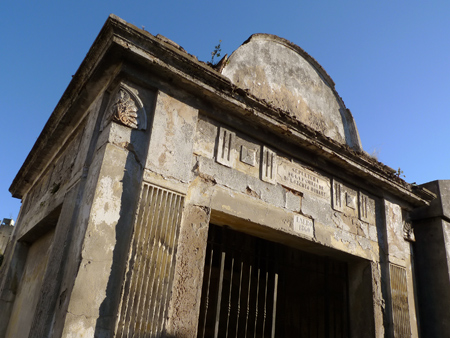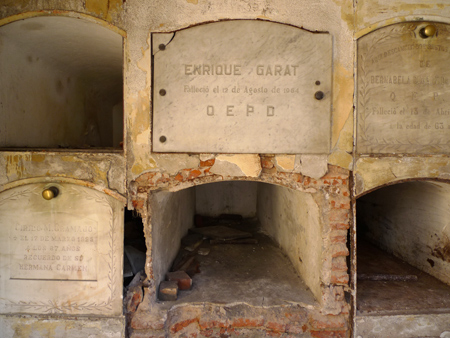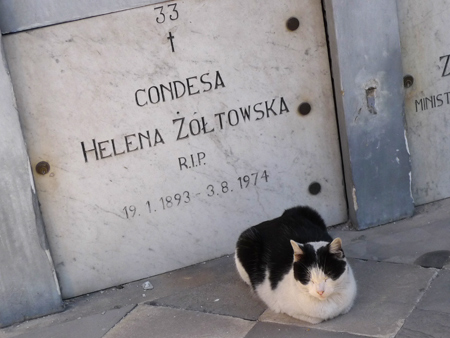
Keeping the Countess company.
2 Comments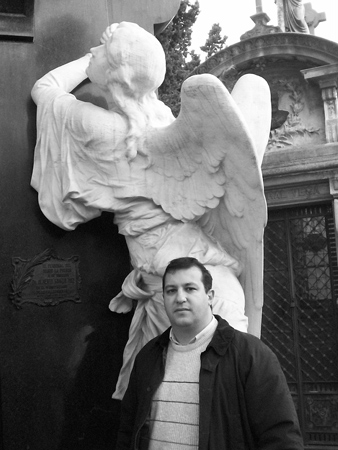
Interview with Diego Zigiotto
Guidebook for the city of the dead by Marcelo Metayer
The author of “1001 Curiosities of Recoleta Cemetery” assures that “there are a lot of people inside that no one knows about” & that he has more than enough material for a sequel.
Diego Zigiotto, a Buenos Aires journalist with a degree in tourism, is also a specialized guide in the city. In 2007 he published “1001 Curiosities of Buenos Aires” & his experience with the most famous burial site in Argentina led him to write his most recent work, “1001 Curiosities of Recoleta Cemetery.”
You’re a newspaper journalist & a tour guide. How do the two professions fit together?
By chance. I was already a reporter, I worked six years in radio, later I quit & began working in tourism. When I started to study tourism (*note: Argentina, like most countries in Europe, has a degree program for tourism), a professor told me: “Since you’re a reporter, you should be a tour guide.” It wasn’t a bad idea, so I began studying to be a guide. I created new routes, one of them being “Curiosities of Buenos Aires.” People told me, “Why don’t you give us something written? It’s a lot of info.” So I began writing. When I had a little over 200 pages, I presented it to a publisher (Cuatro Vientos), put up some cash, family & friends chipped in, & “1001 Curiosities of Buenos Aires” came out. Later the publishing house Norma called where it was re-edited & both careers came together.
How did you start with the book about the cemetery?
I’d always liked this cemetery & for the past two years I’ve worked as a voluntary guide. There were already two books about the cemetery, that of (Oscar) López Mato with good photos & information but with errors, & that of María Rosa Lojo that has some 10 or 12 historical short stories which can’t be used as factual. So I said, I’m going to do something different. There are a lot of people here that no one knows about, but the publisher told me “lighten up a bit because the book will be like a dictionary.”
But there are still a lot of names, over 200…
A bit over 300. And several weren’t included. There were 450 & we cut it down to 315. We removed many because they said we couldn’t justify including them all.
You propose that people send you information to do an update or even a sequel to this book.
Yes. In fact, we began to take out information & they said, “it’s good for a second book.” Later I thought, who would buy it? I still gather info anyway. Lots of specifics were taken away from different entries… how do you put in two pages everything that these people did?
What’s very interesting about the book is that besides historical summaries, there are many anecdotes.
I found them by immersing myself in libraries. I would have liked to have had more time for that… for full-time research & further investigation.
What kind of response have you had?
Those who have written me liked the book. A 16-year old kid told me, “I read your book by mistake. I bought it thinking it was urban myths/stories, but I loved it.” A descendant of the García Mansilla family who has a blog with a lot of their personal history wrote a post praising the book.
How many people worked with you?
Three people. A friend who works in a library searched for biographies for me, & two women from the cemetery researched information in burial records when I couldn’t come myself.
Of the stories which were removed, which do you regret not including?
We argued a lot about those of Zully Moreno & Luis César Amadori. When people take a guided tour & you tell them Zully Moreno is here, they’re interested because they know her & they’ve seen her onscreen. Another that was deleted is the Club Hotel of Sierra de la Ventana.
What is your next project?
I’m not writing anything now. One project was to do “1001 Curiosities of Argentina,” but it seems a bit ambitious.
And the other cemeteries of Buenos Aires?
Another project was Chacarita, but it wouldn’t sell as well & it doesn’t have as much glamour. Still, there are tons of people (Gardel, Bonavena, the Actors & SADAIC pantheons) to fill two books.
————————————
Original article in Spanish not available online. The lead photograph was taken by Marcelo Metayer.
Zigiotto mentioned to Marcelo during the interview that he came across this blog several times while looking for information about Recoleta Cemetery, & he was surprised information about the cemetery was available in English. I checked his bibliography for a mention of AfterLife —it’s currently for sale at the cemetery gate for 58 pesos— but no credit is given. That’s too bad.
Update: A revised digital edition was made available in 2018.
10 Comments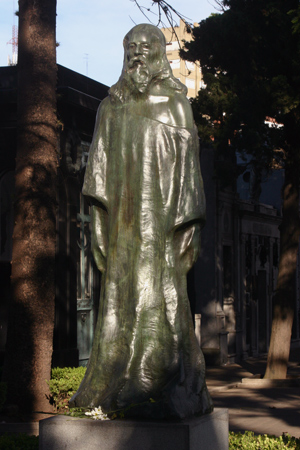
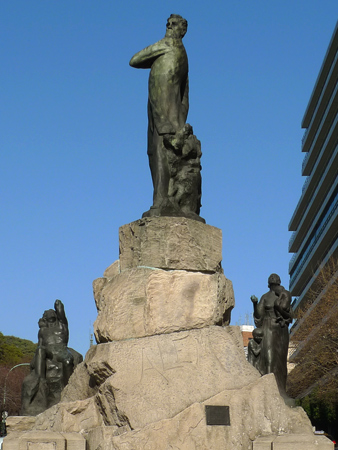
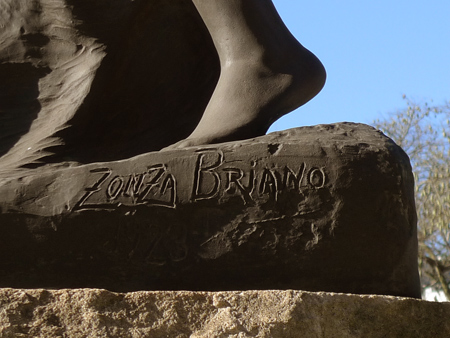
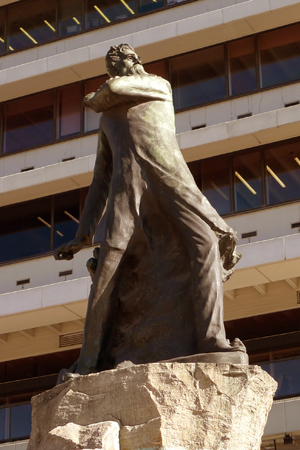
This 1914 sculpture by Pedro Zonza Briano occupies the former center of Recoleta Cemetery where a well was once located. Although famous during his lifetime, Zonza Briano has faded from current public memory. Another of his distinctive sculptures is seen by thousands of people every day as they walk from Plaza San Martín to the Retiro train station… an homage to Leandro N. Alem, founder of the UCR political party & one of the leaders of the 1890 Revolution:
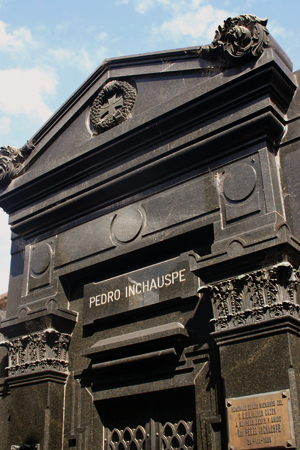
Many people who visit Recoleta Cemetery have heard about Perón’s policy of allowing Nazi war criminals safe haven in Argentina after World War II. But there is another, often neglected part of the story. Argentina could have easily been on the Allied side long before Perón came to power.
Argentina consulted the UK about declaring war on Axis powers in 1939 under the presidency of Roberto Ortiz. England had been Argentina’s chief creditor for decades & one of the major importers of Argentine grain & livestock. But Argentina was advised to maintain neutrality so they could continue to supply food to a nation at war. As a contrast to Ortiz’s willingness to involve Argentina in a conflict in another hemisphere, his government also issued an order to deny visas to any Jewish person trying to escape the Holocaust. His interests were obviously only economic.
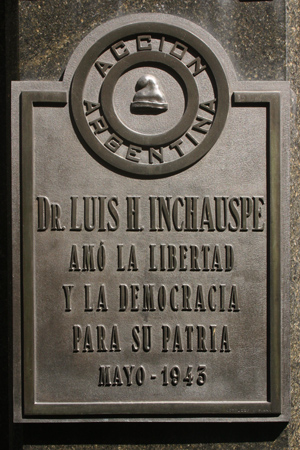
In a response to the horrors of Axis domination in Europe, Acción Argentina formed in 1940 led by ex-President Marcelo T. de Alvear. Although their motives were different than those of Ortiz, they might have been successful in taking Argentina to war if the US had not been attacked in 1941. Dropping their isolationist policy, the US requested at a conference in Rio de Janeiro that all American nations form a united front against Axis powers. To many —including Argentina foreign minister & Nobel Laureate Carlos Saavedra Lamas— the US request sounded like a way to extend their own power to South America & the request was rejected.
Other members of Acción Argentina included Victoria Ocampo, Nicolás Repetto, Alicia Moreau de Justo, & former President Agustín P. Justo. Although total membership was under 500, elite members gave the organization a strong voice.
For more info, check out a book by Andrés Bisso titled “Acción Argentina y las estrategias de movilización del antifascismo liberal-socialista en torno a la Segunda Guerra Mundial, 1940-1946.” Under US pressure, Perón’s predecessor declared war on Germany about 6 months before the conflict was over.
2 Comments