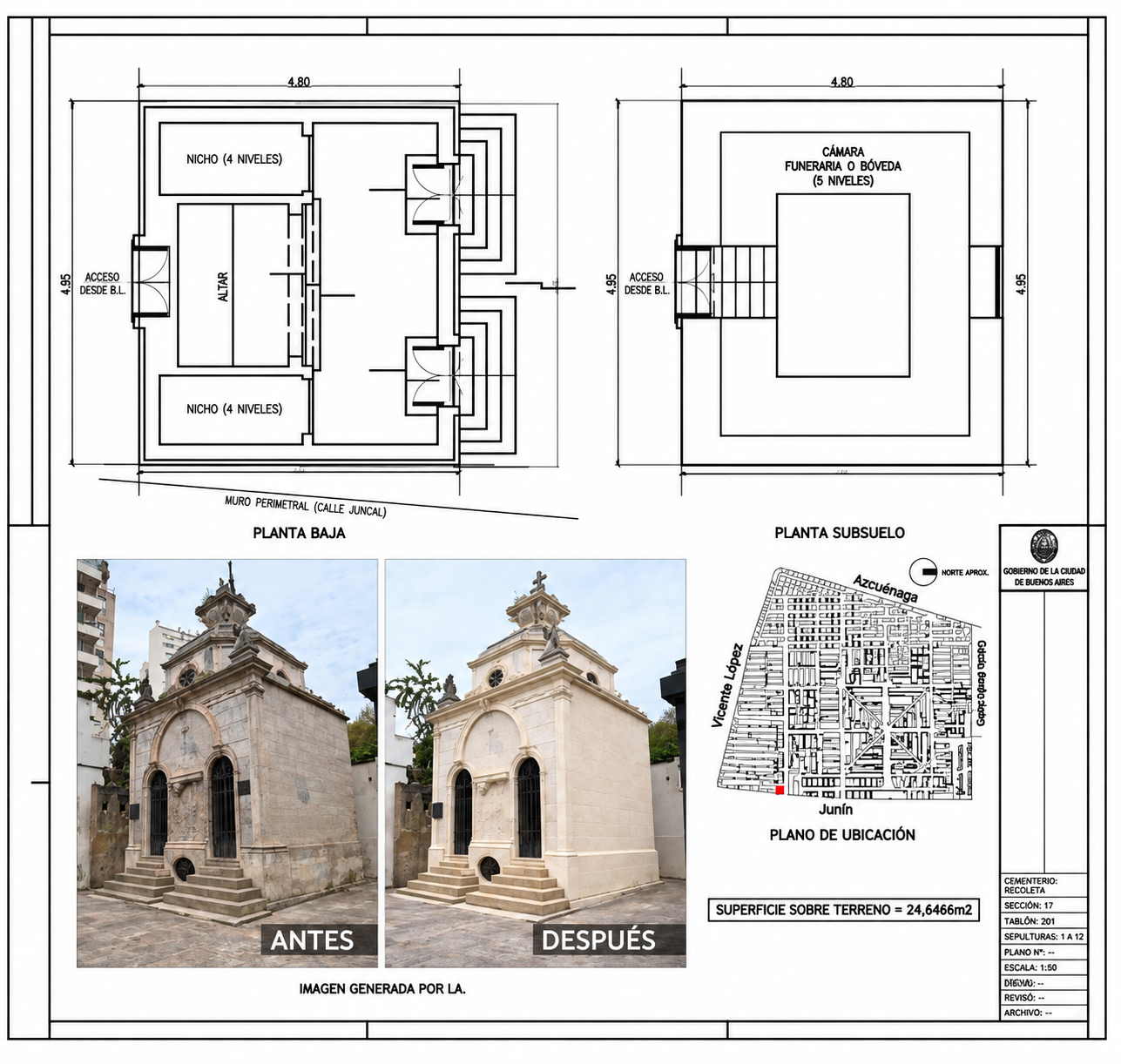
Recoleta Cemetery is not, as one might imagine, a static or immutable place. On the contrary, it is a living site that has undergone changes over the years —some of which have even occurred since this blog went online. In this regard, the most recent controversy involving change in the cemetery arose from a Gobierno de la Ciudad Autónoma de Buenos Aires (the official name for the city government, abbreviated as GCBA) plan —pursued via a public tender— to install a gift shop inside the grounds where visitors could buy souvenirs, book night tours, and purchase food & drinks. This sparked a major debate. The family that owned the mausoleum stepped forward, and following a heated dispute, the city administration was forced to halt the entire process.
Everything began in early August. On the 7th, the GCBA announced its intention to place in public tender the mausoleum identified as “Section 17 – Plot 201 – Graves 1 to 12” for the purpose of “providing comprehensive visitor services, including the operation of a gift shop, a food and/or beverage outlet, and a night tour service.”
To give our readers some context, Section 17 is located at the southwestern end of the cemetery, at the corner of Junín and Vicente López streets. The mausoleum in question sits next to a small exit built in recent years along Junín Street. In fact, the idea was for visitors to purchase these items before leaving the premises, thereby preventing them from consuming food or drink inside the cemetery itself.
Details
In short, Public Tender 10002-1251-LPU26 sought to award a five-year concession for this space located within the cemetery, with a base monthly fee of 1,600,000 pesos (approximately 1,050 USD at the current exchange rate). Additionally, the concessionaire would be required to remit at least 20% of gross revenue generated by night-time tourism activities to the Buenos Aires city government; the final figure was subject to the bidders’ proposals. The opening of bids was scheduled for September 9 via the Buenos Aires Compras portal.
The tender specifications provided further details: the establishment could offer institutional products & souvenirs linked to the history and heritage of the city and the cemetery, as well as simple food and beverages —either packaged or for immediate service, such as coffee and tea— sold exclusively on a take-away basis. In other words, there was no provision for table service, customers remaining inside the premises, or the use of reusable tableware.
Meanwhile, the night-time tourism service was to consist of guided tours & cultural, educational, and recreational activities designed to showcase the necropolis’s historical, artistic, architectural & funerary heritage. Activities were planned for Thursdays through Sundays between 19:00 and 23:00. Naturally, the establishment could remain open during those hours for product sales.
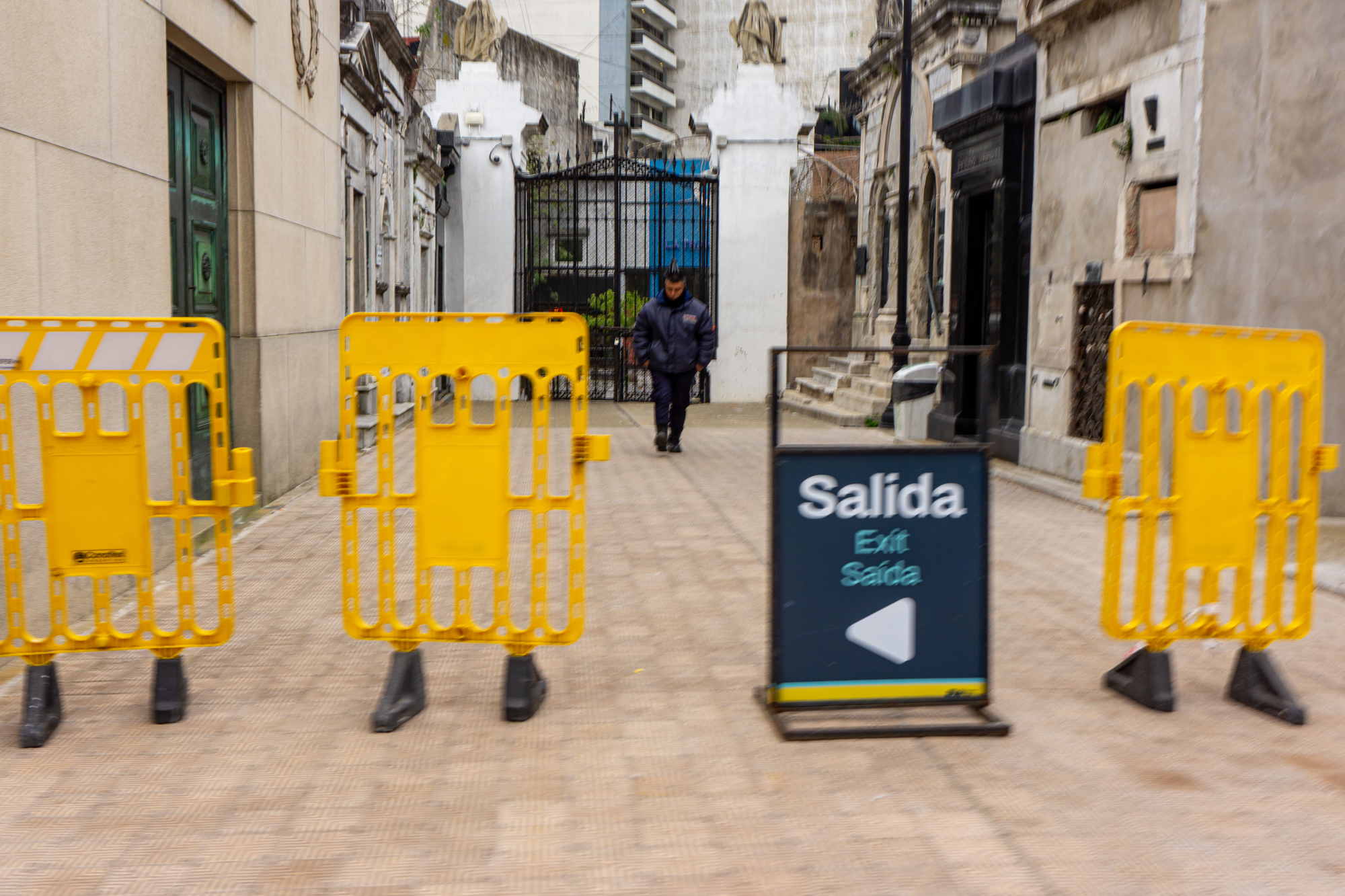
Controversy
Controversy erupted as soon as the tender was announced. Heritage preservation groups associated with the cemetery —most notably the Association of Friends of Recoleta Cemetery (Asociación de Amigos del Cementerio de la Recoleta, ADACRE)— raised a loud outcry.
To begin with, Article 22 of the city’s cemetery law (No. 4977) stipulates:
“All commercial activity, in any form, is prohibited —specifically the sale of vaults, mausoleums, niches, and funeral goods or services— within the grounds of cemeteries owned by the Government of the Autonomous City of Buenos Aires.”
Shortly thereafter, ADACRE issued a detailed statement on the matter. They expressed support for designating the space as a “Cultural Information and Outreach Center” but deemed the dining operations outlined in the tender specifications as “inappropriate.”
Nevertheless, they emphasized that “the coexistence of a heritage cemetery and a dining service is not technically impossible anywhere in the world. In every instance, it is a matter of institutional judgment made by those responsible for the site’s preservation.” Finally, they called for a “joint analysis to determine the most suitable approach” —one that would “safeguard the space’s cultural purpose, secure genuine funding for the cemetery’s restoration, and avoid the institutional strain that neither party desires.”
In the British Cemetery
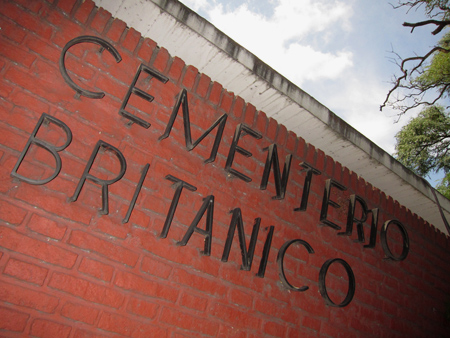
Amidst this ongoing debate, AfterLife contacted the Cementerio Británico of Buenos Aires —one of the two “dissident cemeteries” adjacent to Chacarita Cemetery. The British Cemetery operates a service selling drinks, cookies and alfajores via vending machines located in a space next to the entrance; we wanted to understand how this system works, given the controversy surrounding the situation in Recoleta. Cemetery administrators told us: “First of all, a distinction must be made: Recoleta Cemetery is public, whereas our institution is private. Under our bylaws, we are permitted to engage in any activity —not just burials, but anything related to the proper management of the burial grounds.”
They added that the area where drinks and snacks are sold “wasn’t set up in a burial vault, but rather where the restrooms used to be. We haven’t had any issues, but it is a different situation because our operating permit allows for it. In the case of Recoleta, the vault doesn’t belong to the cemetery itself but to a family —unless, after a certain number of years, it reverts to the cemetery’s ownership, given that it is a public facility.” They concluded: “Any private cemetery has a reception area, an office, vending machines, and a coffee station.”
Public space or private vault?
The tender process obviously clashed with the legal framework of the Autonomous City of Buenos Aires… So how should this to be interpreted?
The provision calling for the establishment of this business refers to “a space located within the property known as Recoleta Cemetery” —meaning it does not use the word “vault.” Furthermore, it notes that the space would be a “public asset” belonging to the city. Jorge Macri’s administration stated —as reported by the newspaper Clarín— that the vault in question had been abandoned: “After the administrative procedure established by law was completed, it was returned to the city government.”
They explained that “some of the individuals who filed claims are not the vault’s titleholders; therefore, we believe the formal legal notice will have no effect. In the case of the Girado family, there are 30 titleholders, yet none of them has paid a single peso for the vault’s concession over the last 20 years. Specifically, the outstanding debt for the 2007–2026 period amounts to $22,215,070 [pesos].” That’s over 14,500 USD at present.
“Public notices have been published since 2025, formal legal notices were sent, and they also owe money for repairs to the vault —a total of $15,587,653,” they asserted.
Family pressure
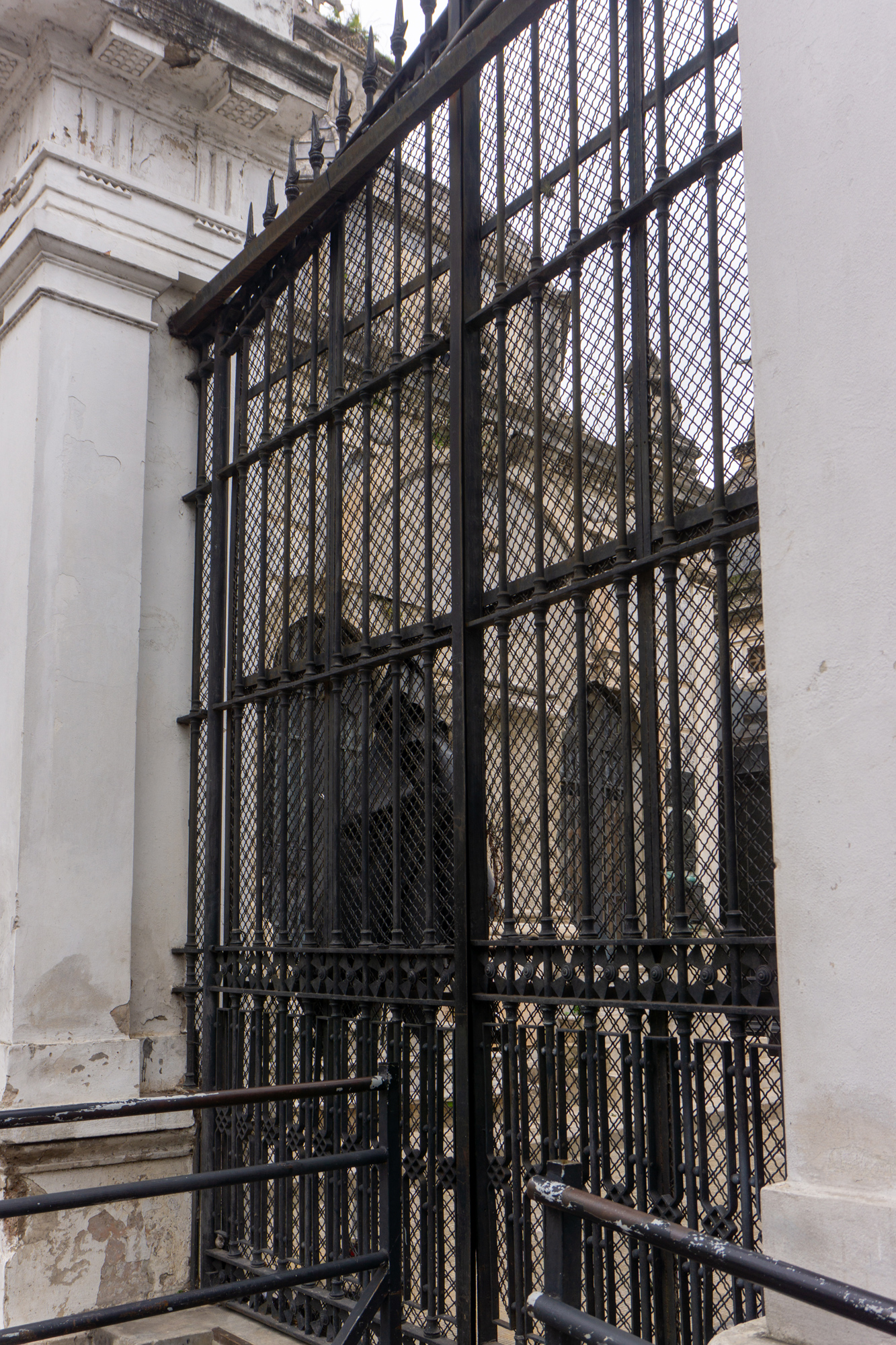
But the Girado family, owner of the aforementioned “space,” counterattacked. “The tender was called while our deceased, our family, are still in the vault,” said lawyer Pablo Girado Passo. He said that it is a perpetual concession & that the vault was built in 1880. “We request the annulment of everything that has been done. Because the law also establishes that to recover ownership, the government has to reliably notify heirs. However, the notifications reached addresses where no heir lived,” he explained.
Specifically, Lucía Girado, the sister of the aforementioned lawyer, presented the file “Girado Lucía v. GCBA s/ amparo”, No. 193444/2026-0, before the Buenos Aires Contentious Administrative and Tax jurisdiction. Judge Roberto Gallardo acted there, ordering the vault to be opened and inspected on August 20, with the presence of Lucía, her lawyers, representatives of the Attorney General’s Office and cemetery authorities. After that inspection, on August 21, Gallardo decided to close the vault. During the visit, photographic and film records of the interior were made.
Finally the judge ordered the GCBA “to refrain from issuing the expiration of the concession of the land formed by graves 1 to 12 and the rest of No. 201, Section 17 of the Recoleta Cemetery, as well as from arranging for its eventual bidding or public auction.”
Thus, on August 26, the Buenos Aires Government published in its official bulletin a provision that “repeals the single-stage Public Tender No. 10002-1251-LPU26 for the granting of the concession for use and exploitation on an onerous basis of a Space located inside the property called Cementerio de la Recoleta, located at Junín No. 1760 of the Autonomous City of Buenos Aires.”
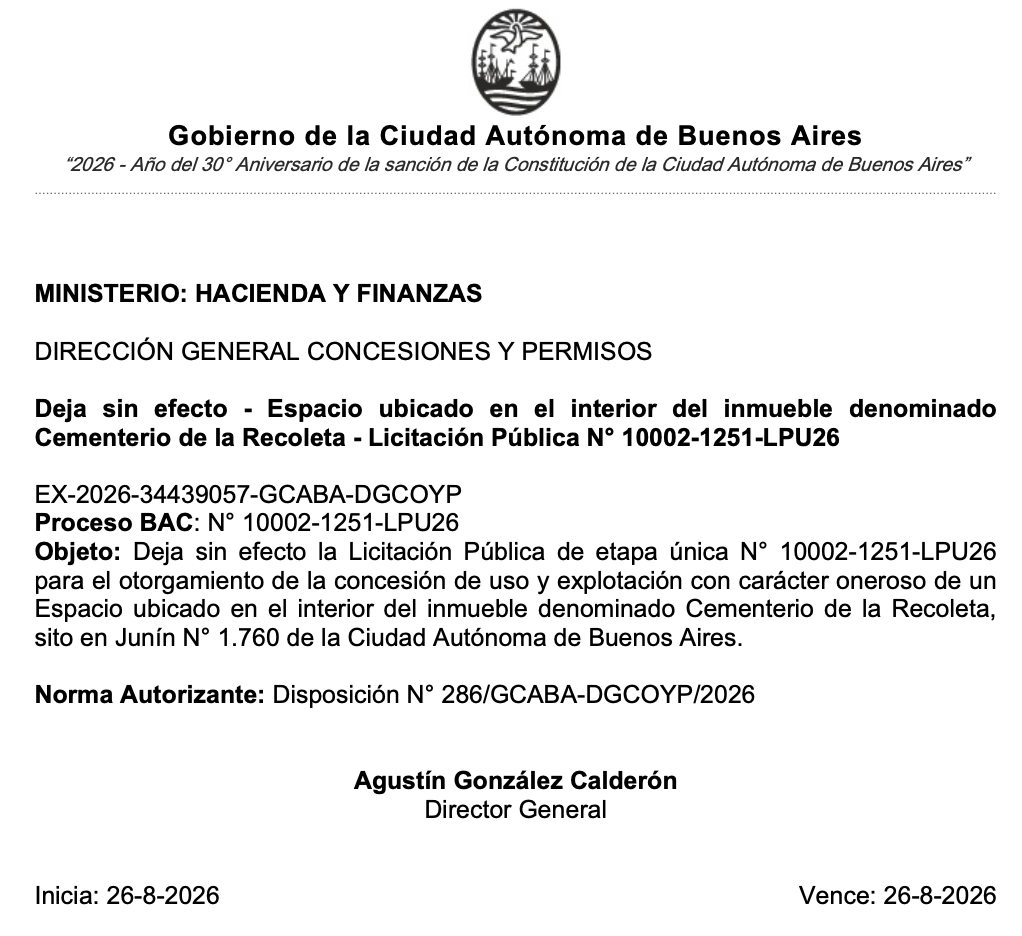
It all ended there. Although the judge, according to media in the Argentine capital, suggested that the Buenos Aires city government had initiated a second step, aimed at lucrative commercial exploitation in a place that could be outside the cemetery.
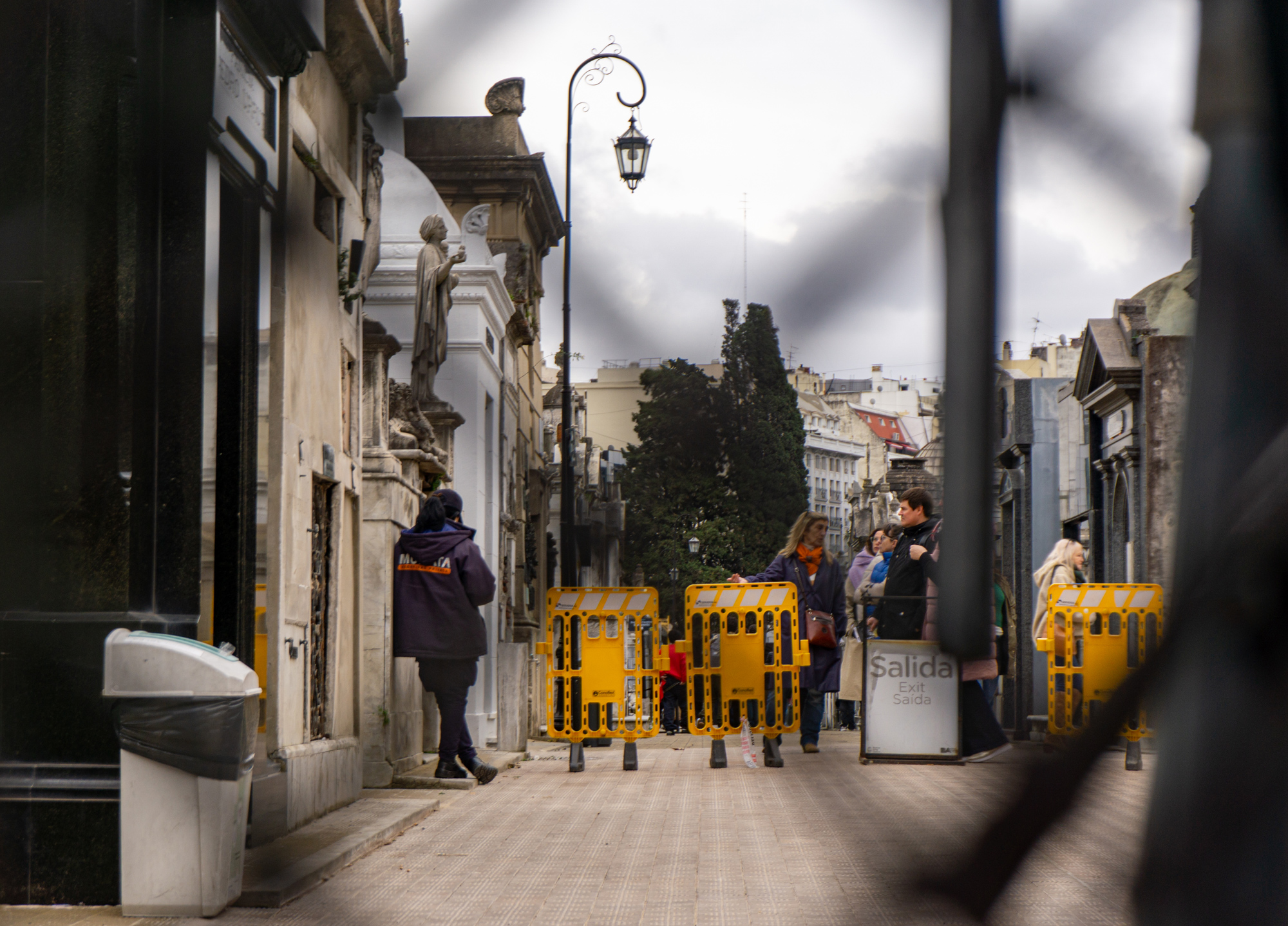
Although this first project ended in favor of the Girado family, we’ll have to wait & see if some type of kiosk is built outside cemetery grounds to provide visitors with basic services. The regular exit to Recoleta Cemetery should be back to normal now!
Be First to Comment