Documenting Recoleta Cemetery in Buenos Aires since 2007
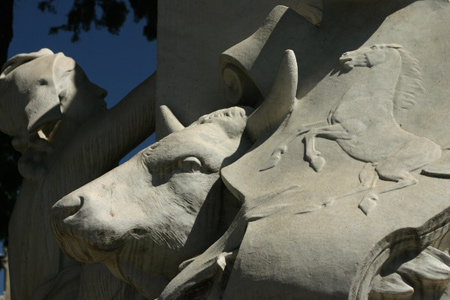
Given that Argentina’s wealth has traditionally derived from cattle while rich, landowning families preferred to be buried in Recoleta Cemetery, bovine imagery should be everywhere. Unfortunately cattle don’t receive much tribute from their former owners.
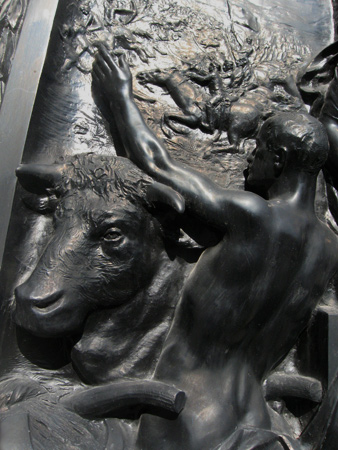
The largest & most decorative bit of beef stares at visitors from the tomb of Carlos Pellegrini. Founder of the Jockey Club, Pellegrini gathered the elite together for social networking & political objectives:
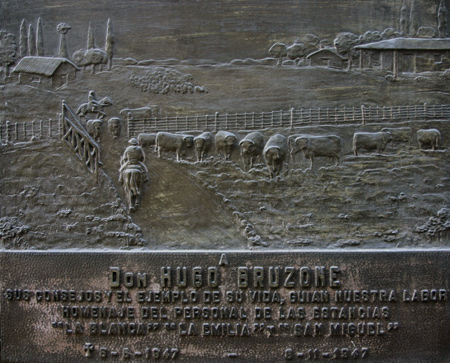
Hugo Bruzone was loved by the employees of his many ranches:
In the aftermath of the Campaña del Desierto, immigrants flocked to Argentina to work the land & tend herds of cattle as shown on a gigantic plaque for Julio Argentino Roca:
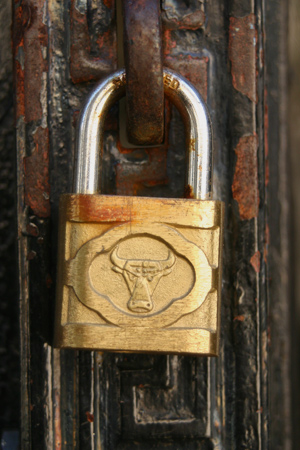
Most original, the logo for a padlock company named “Bull” keeps unwanted visitors out:
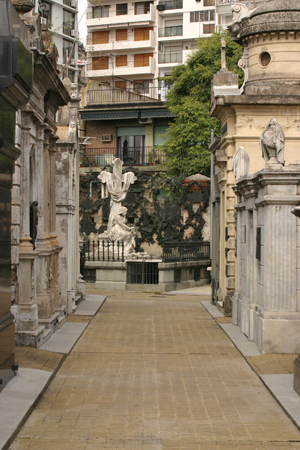
Oriented for maximum attention, a statue of a seated woman marks the end of a walkway in the rear section of the cemetery. Neighboring tombs have been skillfully used as a frame:
The base of the statue group aligns correctly with the family crypt, but both cross & woman turn slightly to take advantage of the location & impress visitors:
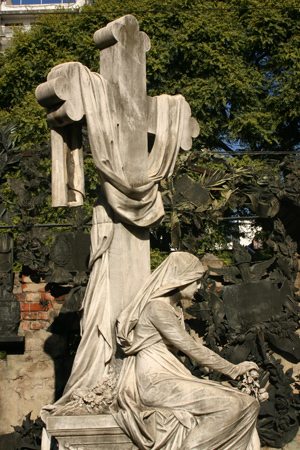
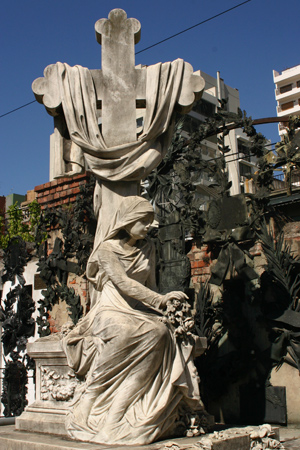
The most famous member of the González family is actually an in-law. Roque Sáenz Peña married Rosa González Delgado (daughter of Lucas), & the entire back wall is covered with plaques dedicated to Roque. This is an important reminder that visitors should always pay attention to plaques:
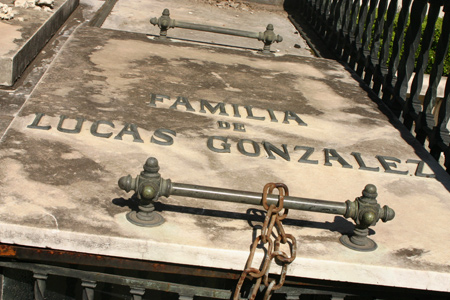
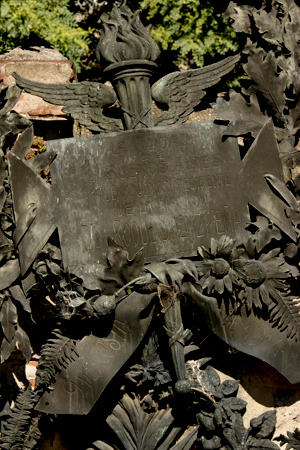
Both Roque & his father, Luis, had influential careers in politics. During the 1890s father & son were manipulated by opposing factions to run against each other for the presidency. Roque took the high road, declined his own nomination, & let his dad win. He’d get another opportunity, & Roque became President in 1910.
Roque Sáenz Peña did something unexpected after two years in office… he ended decades of election fraud which put families like his own in power & gave the right to vote to every male in Argentina. Universal male suffrage went into effect in 1912, but Roque would not live to witness the first popular election. Dying in office in 1914, Vice-President Victorino de la Plaza took over until Roque’s six-year term finished. In 1916, Hipólito Yrigoyen became the first President elected by popular vote.
Women didn’t receive the right to vote until 1947—one of the lasting accomplishments of Eva Perón. Her motivations were likely more political than for women’s rights since she counted on all the new voters to re-elect Perón for a second, consecutive term in 1952.
Update (30 Dec 2011): This crypt was declared a national historic monument in November 2011.
4 Comments