Skip to content

Category: Art + Architecture

022. julián garcía y familia

Julián García Núñez, Recoleta Cemetery

Born in Buenos Aires in 1875 to Spanish immigrant parents, Julián García Núñez was sent to complete his architecture studies in Barcelona. He arrived at the beginning of the Art Nouveau period, just as Barcelona got its distinctive look. Although Gaudí is the most recognized name of Barcelona architecture of that era, Domènich i Montaner was equally as prolific & García Núñez fortunately had him as a professor.

Returning to Buenos Aires around 1905, García Núñez brought with him a touch of Barcelona to the growing metropolis of Buenos Aires. He wasn’t shy about promoting himself & was awarded with important contracts for the immigrant Spanish community, most notably the Hospital Español (now 80% demolished). For Argentina’s centennial celebrations in 1910, GN built the Spanish Pavilion & his designs were increasingly in demand.

But when Art Nouveau fell out of fashion in Buenos Aires & gave way to Art Deco, García Núñez abruptly stopped practicing his profession. Only a few works date after 1915, & apparently he destroyed all his plans & awards. Surviving family members recall GN having a rather stern character, but we’ll never know why he abandoned everything & faded into obscurity.

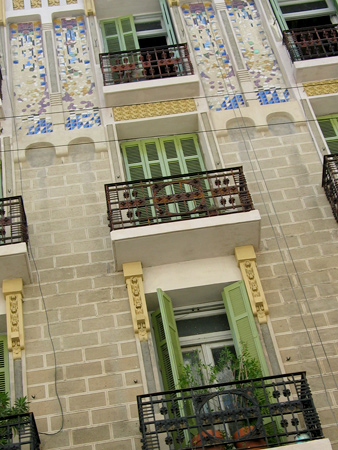
The buildings by García Núñez in Buenos Aires which have not been demolished or modified remain as striking today as when they were built. Below are apartment buildings at Otamendi 76-82 (Caballito), Paso 684-98 (Once), & Luis Sáenz Peña 274 (Monserrat):
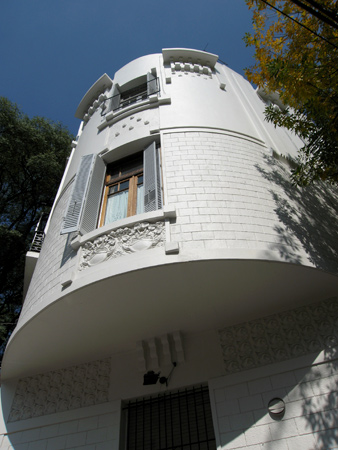
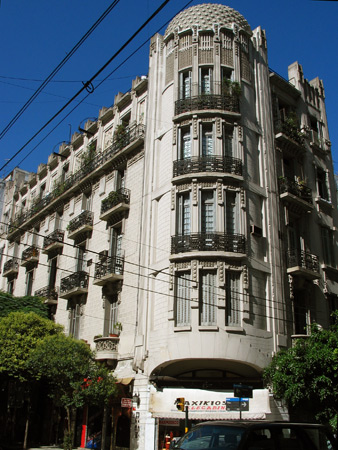
Julián García Núñez, Otamendi 76-82

Julián García Núñez, Paso 684-98

Julián García Núñez, Luis Sáenz Peña 274

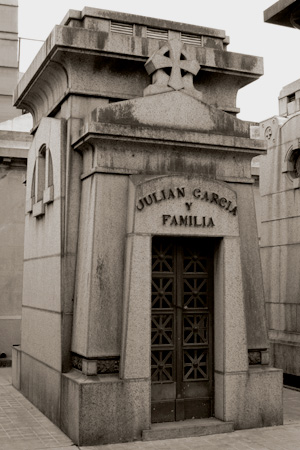
His neglected family tomb lacks the style García Núñez was most recognized for but is nevertheless nicely designed:
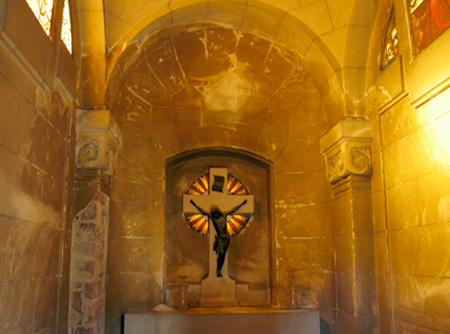
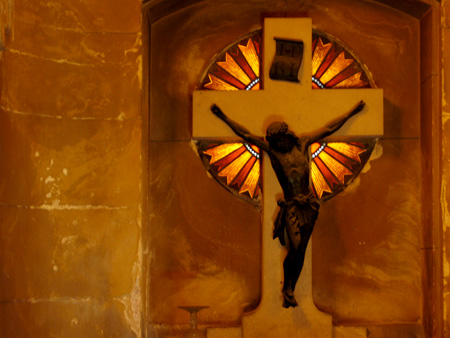
Julián García Núñez, Recoleta Cemetery

Julián García Núñez, Recoleta Cemetery

Julián García Núñez, Recoleta Cemetery

Like Art Nouveau? Learn about the architects of the era, their individual styles & what makes Art Nouveau in Buenos Aires so unique with a 33-page guide from our sister site, Endless Mile. Works of García Núñez are highlighted in the guide.

1 Comment
019. romulo otamendi ◊

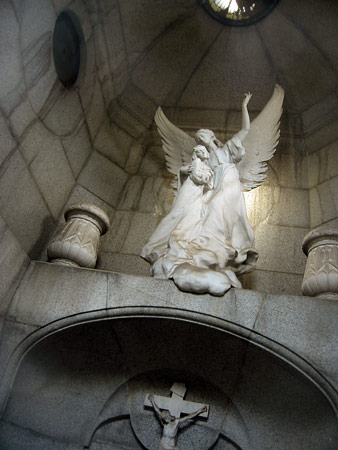
Difficult to miss, this granite monster is unremarkably cold, grey & lifeless. But if the glass window behind the wrought-iron door is open, be sure to peek through… one of the most beautiful statues of Recoleta Cemetery sits inside. The interior of the mausoleum has significant water damage thanks to broken ceiling glass, but the sculpture has been spared from the elements:

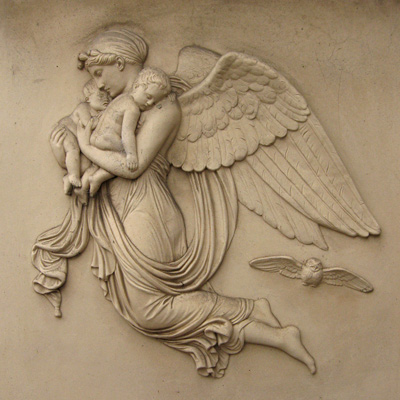
Rómulo Otamendi, Recoleta Cemetery

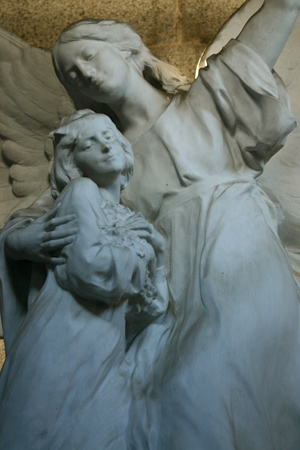
An angel with exquisite wings carries a child to heaven on a cloud. Both look completely content & offset what was a terrible tragedy for the Otamendi family. Their only daughter, Estela Matilde Otamendi, died in 1916:

Rómulo Otamendi, Recoleta Cemetery

Romulo Otamendi, born in 1852, worked an engineer & was responsible for laying out a large portion of the Argentine railroad network. He was compensated with land holdings & a small town was established near the railroad station named after him. On Otamendi’s death in 1934, much of the land was willed to the national government. After decades of neglect, it was recovered & became a nature reserve in 1990. The 3,000 hectare area is about 70 km northwest of Buenos Aires, near the city of Campana, & is hoping to become the first national park in the Province of Buenos Aires.

The Otamendis spent their summers in a sumptuous estate along the Tigre Delta known as the Palacio Belgrano. Originally constructed in the 1860’s for Carlos Belgrano, brother of independence hero Manuel Belgrano, the German/Italian-influenced castle had been decorated with all the European elegance money could buy:

Palacio Belgrano

When daughter Estela passed away, the estate was donated to the local government & a shelter for girls now operates there. Above the main entrance of this mausoleum, Estela’s name figures between those of her father & mother.

[Palacio Belgrano photo courtesy of the Municipalidad de San Fernando.]

2 Comments

011. eduardo orfali ◊

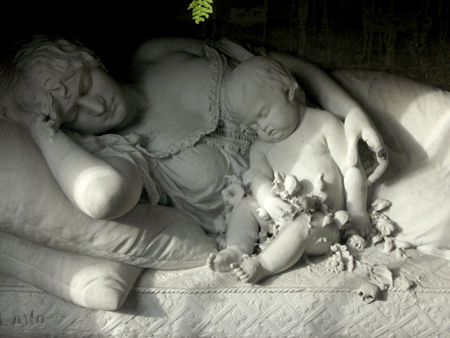
Eduardo Orfali, Recoleta Cemetery

Inside this small tomb is a beautiful sculpture from Milan, placed on the floor along the back wall. Stoop down to get a better view of the marble masterpiece, & note the embroidery of mom’s evening gown, her slightly fallen breasts, & the detail of the mattress. According to Buenos Aires Nos Cuenta #13, the structure originally belonged to the Viviani-Rossi family who obviously had a lot of money & very good taste.

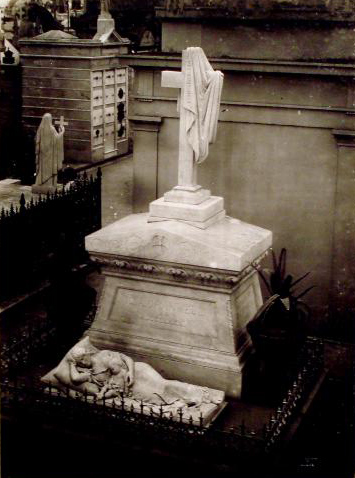
Update (08 Feb 2012): Good to debunk another bit of misinformation. Wherever Buenos Aires Nos Cuenta obtained their info, they are incorrect. An extensive amount of the Witcomb Collection, taken at the end of the 19th & beginning of the 20th century, is now available online. Photo #372 shows the statue in the same location as today but as part of a larger mausoleum belonging to C.A. Cranwell.

Eduardo Orfali, Cranwell, Colección Witcomb

This south-facing sculpture is best viewed in late afternoon when the setting sun reaches inside. Large glass panels make flash photography awkward, so natural light is the best option.

2 Comments