Skip to content

Category: Art + Architecture

165. rufino de elizalde ◊

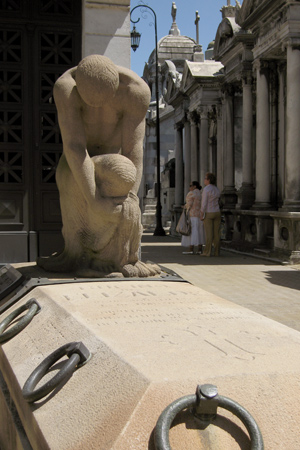
Rufino de Elizalde, Recoleta Cemetery

Many historians refer to Rufino de Elizalde as the first politician with a clear vision of Argentina’s future. His participation in numerous debates across the Americas & Europe left no doubt about Elizalde’s stance. Born in 1822 into a lower class military family in Buenos Aires, Elizalde put himself through law school & graduated in 1846. Joining the anti-Rosas factions, he quickly moved up in political circles, served in Congress & became a close ally of Bartolomé Mitre.

That allegiance paid off when Mitre became President in 1862. Appointed as Minister of Foreign Relations, Elizalde first voiced what Argentines have become known for—their strong ties to Europe & semi-rejection of their neighbors. This is particularly striking considering Elizalde lived decades before European immigration to Argentina began in earnest. His most famous quote states:

Es claro que existen mayores vínculos, mayores intereses, mayor armonía entre las repúblicas americanas y ciertas naciones europeas que entre las repúblicas americanas mismas… América, al contener naciones independientes, con sus propios medios y necesidades de gobierno, no puede formar una entidad política unitaria.

It is clear that better ties, more interests, better harmony exists between American republics & certain European nations than between the American republics themselves… America, consisting of independent nations, with their own means & government needs, cannot form a united political entity.

The big problem of Elizalde’s era was obviously where to form alliances. The Monroe Doctrine of the United States threatened to become Pan-American, & several nations tried to limit US influence from spreading further south. Argentina had a privileged position, far enough from the US to shift its concerns to other national projects.
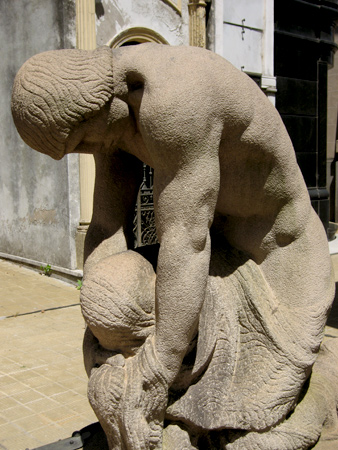
Rufino de Elizalde, Recoleta Cemetery

Elizalde wanted to become President after Mitre but was beat by Sarmiento. Reclaiming his role as Minister of Foreign Relations under Avellaneda, Elizalde continued to serve in various government positions until a few years before his death in 1887.

The underground mausoleum obviously dates from a later era—that of Art Deco—but a plaque gives us a clue. Elizalde’s son also shared his name & was President of the Buenos Aires Rowing Club. The son must have secured this space for his father as well as his own descendants:
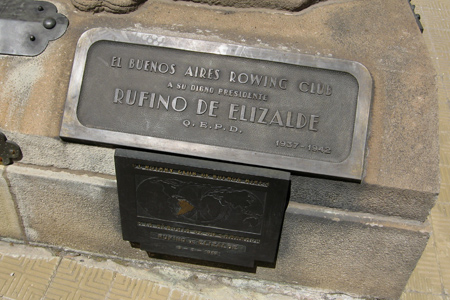
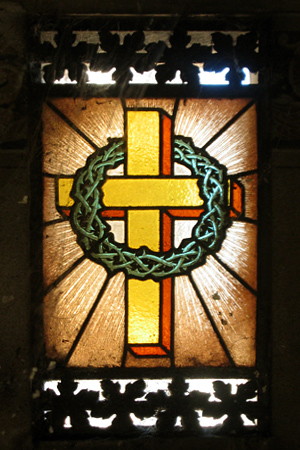
Rufino de Elizalde, Recoleta Cemetery

Leave a Comment

162. neo-prehispanic

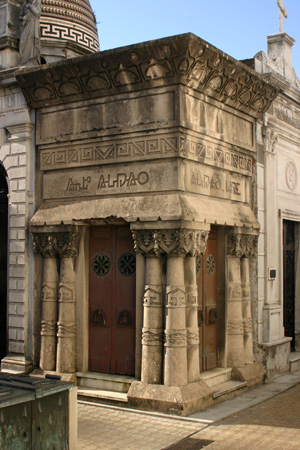
Atilo Aldao, Recoleta Cemetery

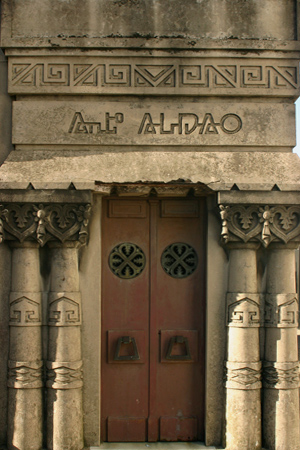
As part of an architectural & cultural movement from 1860 to 1900, nations once controlled by Spain began examining & re-evaluating their past. Dubbed Neoprehispánica, native imagery & patterns inspired the arts & was most popular in Mexico. Due in part to distance & also because Argentina had not preserved much of its pre-Hispanic past, the movement only caught on locally in the 1920s & 1930s. Its geometric designs fused well with Art Deco. Some of the architects to embrace Neoprehispánica in Buenos Aires were Ángel Guido, Martín Noel & Estanislao Pirovano.

The Aldao family mausoleum is unique in Recoleta Cemetery. While others with touches of this style exist, Atilo (Atilio or Antonio) Aldao made a bold statement:

Atilo Antonio Aldao, Recoleta Cemetery

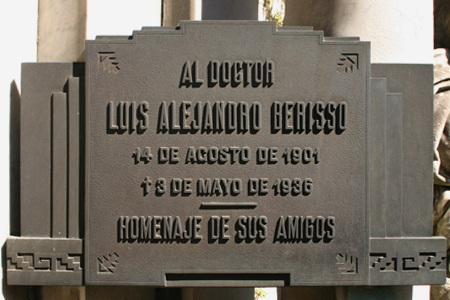
Other places to look for this style are on plaques dedicated during that era:

Luis Berisso plaque, Recoleta Cemetery

10 Comments

157. manuel quintana ◊

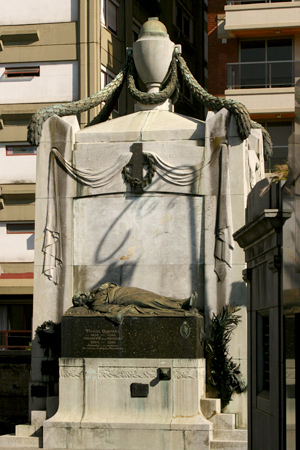
Manuel Quintana, Recoleta Cemetery

A life-long statesman, Quintana held a number of important positions during his political career, mainly in Congress. He eventually rose to be among the political elite & won the presidency in 1904. The following year, an uprising by the UCR got his term off to a shaky start. Already in his 70s, Quintana’s health was weakened by having to deal with the uprising. A few months later an anarchist from Spain tried to assassinate Quintana. The revolver failed to go off, but Quintana was so distraught from the incident that he eventually stepped down from office & his Vice President took over. Quintana died a few months later in 1906.

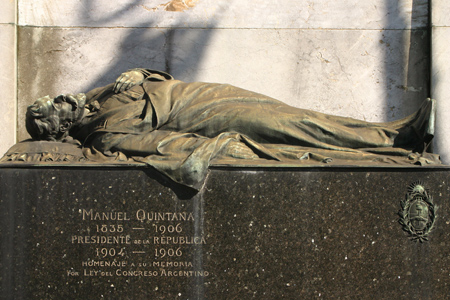
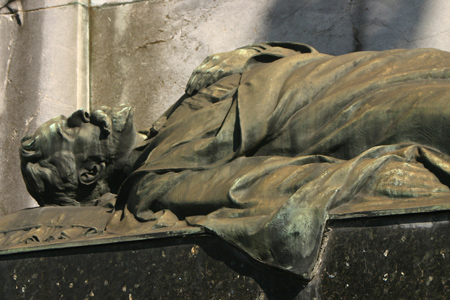
What’s most striking about this tomb is its grandeur & elegance. It’s so large that you really have to step back in order to appreciate the decoration. Also, the effigy of Quintana literally resting in peace is not common in Recoleta Cemetery. Sculptures usually take the form of the living person (as in the boxer Luis Ángel Firpo) or heavenly figures such as angels & cherubs. It’s certainly an elegant exception to the norm:

Manuel Quintana, Recoleta Cemetery

Manuel Quintana, Recoleta Cemetery

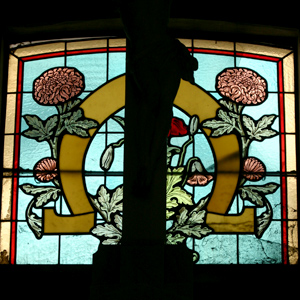
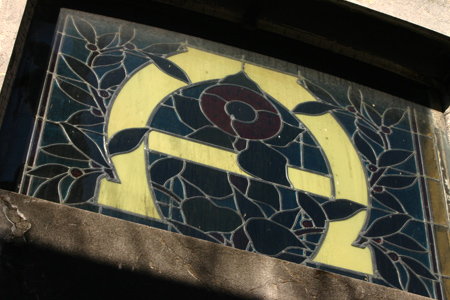
The interior of the vault is oddly divided. The left side door leads downstairs to dark underground storage. On the right side, another door opens to a small staircase leading up to the main altar. An Omega shines through a beautiful piece of Art Nouveau stained glass, while the Alpha is above the door & can only be viewed from the interior:

Manuel Quintana, Recoleta Cemetery

Manuel Quintana, Recoleta Cemetery

Leave a Comment