Skip to content

Author: Robert

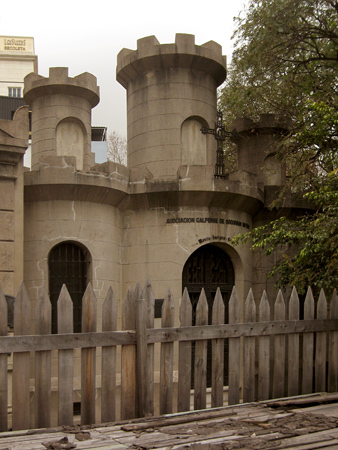
202. asociación calpense de socorros mútuos ◊

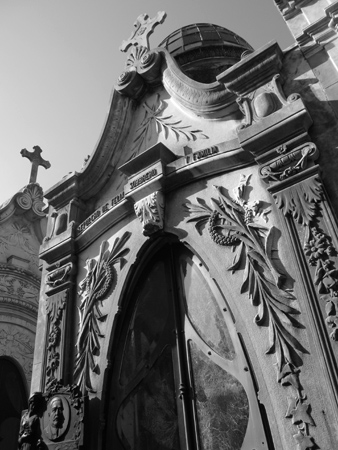
Asociación Calpense, Recoleta Cemetery

There’s a castle in the cemetery, but most people never see it. Stuck in a corner down a dead-end aisle, the organization whose members are be buried here often go unnoticed.

The Calpense Association for Mutual Assistance was one of many groups formed by immigrants from a specific region in Europe to assist new arrivals from their hometown. These organizations founded hospitals (important when immigrants could speak little Spanish) & gave women an outlet away from the home. So who were the Calpenses?

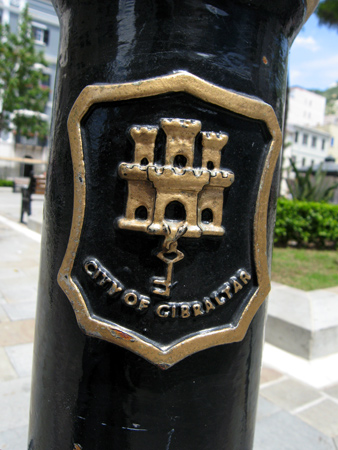
Phoenicians trading in the Mediterranean 3,000 years ago christened a landmark mountain “Calpe.” Called Gibraltar today, the British Commonwealth has controlled “the Rock” since the early 1700s. The mausoleum’s castle design originated from a coat of arms granted by Queen Isabel —the same one who funded the voyage of Columbus— since the area belonged to at that time. That original coat of arms was incorporated into the modern Gibraltar flag, then reproduced in Recoleta Cemetery. The vault is a perfect copy:

City of Gibraltar, post

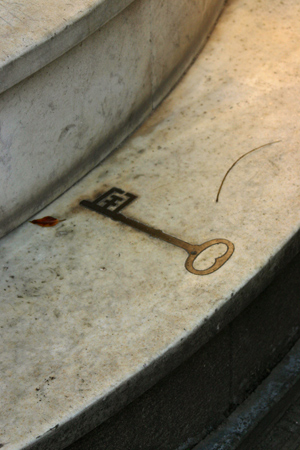
The hanging key on the coat of arms also forms part of the vault… look down at the doorstep to find it:

Asociación Calpense, Recoleta Cemetery

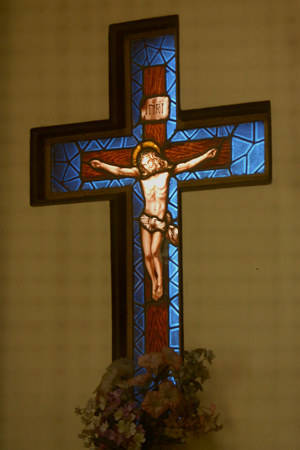
The interior is wide & spacious, & the stained glass on the back wall is worth a peek inside:

Asociación Calpense, Recoleta Cemetery

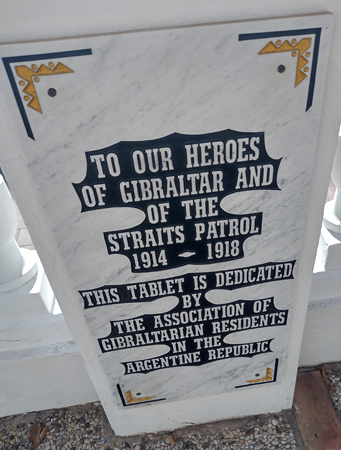
Update (20 Dec 2023): During a recent trip to Gibraltar, I found the following plaque near a World War I monument by King’s Bastion. Ties to immigrants ran deep in the early 20th century.

Gibraltar, plaque, Recoleta Cemetery, Straits Patrol
Leave a Comment

200. ventura coll

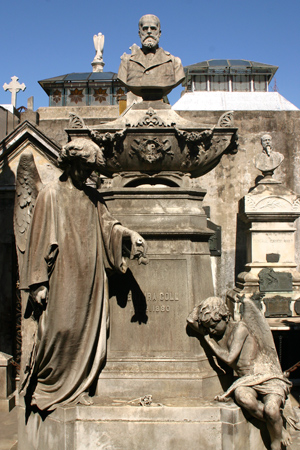
Ventura Coll, Recoleta Cemetery

Hidden among a series of short rows, Ventura Coll gets little attention these days & even fewer people remember who he was. An inscription on the back side made the search for background info easier:
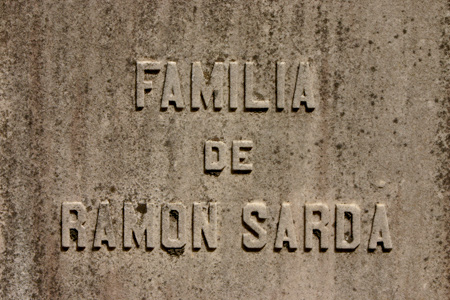
Ramón Sardà, Recoleta Cemetery

Thanks to some helpful people at the Province of Santa Fe historical society, I learned that Ventura Coll was a doctor there, somewhere in the province… that’s all anyone knew about his life. But Ventura’s sister, Victoria Coll, married Joaquín Marull & had a daughter named Delfina. Delfina married Ramón, so that’s how the Sardá line also wound up in Recoleta Cemetery with the Colls.

All these last names are Catalán, & Sardá was also a doctor. Seems that Coll stuck to a tight social circle of Catalan immigrants. The historical society also provided me with a wonderful photo with Ventura Coll (left) & Ramón Sardá (right). The bust on the grave is remarkably accurate:
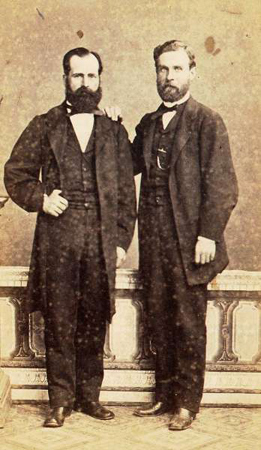
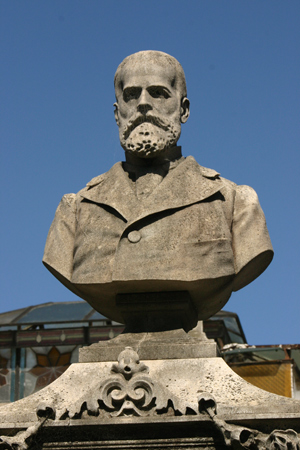
Ventura Coll & Ramón Sardá

Ventura Coll, Recoleta Cemetery

The statue of the boy angel may seem familiar to regular readers of this blog because the same statue also decorates the Francisco Gómez family vault:
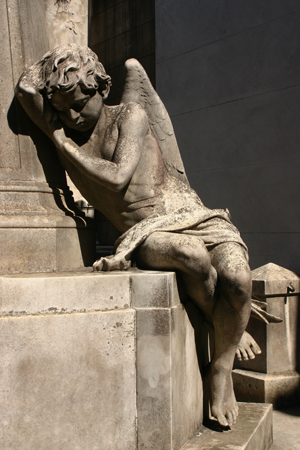
Ventura Coll, Recoleta Cemetery

Delfina & Ramón Sardá had no children, so it’s interesting to note that they donated money to establish a maternity hospital in Buenos Aires. Opened in 1934 in the neighborhood of Parque Patricios, the building is textbook Art Deco & one of the most important public hospitals in the city. With over 6,000 births per year, no wonder it was immortalized in the 1954 movie “Mercado de Abasto” with Tita Merello & Pepe Arias:

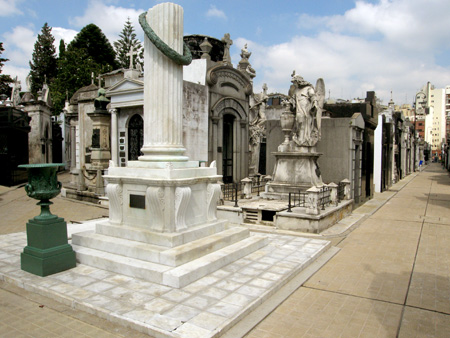
Hospital Ramón Sardá, Parque Patricios

4 Comments

198. vicente lópez y planes

Vicente López y Planes, Recoleta Cemetery

With today marking the 198th anniversary of Argentina’s declaration of independence, there’s no better time to discuss the author of the national anthem.

Born in Buenos Aires in 1785, Vicente López y Planes participated in every important event leading to the birth of the new nation. His political career began as secretary of the short-lived First Triumvirate, & he maintained a close friendship with Manuel Belgrano.

As the fight for independence continued in other parts of Argentina, López y Planes was requested to write the lyrics for a military march which later became the national anthem. First played in 1813 at the home of Mariquita Sánchez de Thompson then publicly debuted on May 25th that same year, the song bitterly attacked Spain… a normal reaction given that they were at war. The anthem was later changed to remove the nasty references to Spain, & a shorter version was officially adopted since the original ran a bit long:

Mortals! Hear the sacred cry:
Freedom, freedom, freedom!
Hear the noise of broken chains,
see noble Equality enthroned.
Rises to the heights of the Earth
a new and glorious nation,
its head crowned with laurels,
and at her feet lying a Lion.

Chorus:
May the laurels be eternal,
the ones we managed to win.
Let us live crowned with glory…
or swear to die gloriously.

As minister under the first President Bernardino Rivadavia, López y Planes took charge of the 1827 interim government when Rivadavia resigned. After his one-month presidency ended, he maintained an active role in national politics mainly in the judiciary branch. Other intellectual pursuits found López y Planes as part of a literary society founded by Marcos Sastre.

López y Planes died in 1856, & his crypt was declared a National Historic Monument in 1946. Simply decorated with four corner posts connected with chains, numerous plaques occupy the walls of neighboring tombs. New plaques are generally made of marble instead of bronze or other metals:

Vicente López y Planes, Recoleta Cemetery

The full text of both the original & modified versions of the Argentine national anthem can be found on Wikipedia along with an instrumental recording.

Leave a Comment